


Table of Contents
- What You'll Need Before You Start Measuring
- How to Measure a Dog for a Sweater: Step-by-Step
- How to Measure Dog Chest for Clothes (The Most Important Number)
- Reading a Dog Sweater Size Chart Without Guessing
- Dog Sweater Fit Tips for Hard-to-Measure Dogs
- Breed Nuances and Material Differences That Change the Fit
- Common Measuring Mistakes and a 30-Second Fit Check
- Conclusion
- Frequently Asked Questions
Last Updated: September 10, 2026
What You'll Need Before You Start Measuring
A soft measuring tape and treats are all you need to measure a dog for a sweater; a second pair of hands just makes it faster.
Here's what to gather before you start:
- Soft measuring tape: A tailor tape or flexible fabric tape. A rigid ruler or metal tape will bridge over curves and give you a false reading.
- High-value treats: Small, smelly rewards keep your dog anchored in a standing position.
- A helper: Optional, but useful for wiggly dogs.
- The sweater's sizing chart: Print it or pull it up on your phone. You'll compare numbers in real time.
Posture matters more than the tape. A measurement taken while your dog is sitting or curled up will be wrong, sometimes by several centimeters (akc.org). Get them standing square, and every number after that becomes reliable.
How to Measure a Dog for a Sweater: Step-by-Step
Measuring a dog for a sweater takes about three minutes and comes down to three numbers: back length, neck circumference, and chest girth. Take all three with the dog standing square and the tape snug but not tight. Back length sets the garment size, neck circumference decides collar comfort, and chest girth determines whether the sweater closes.
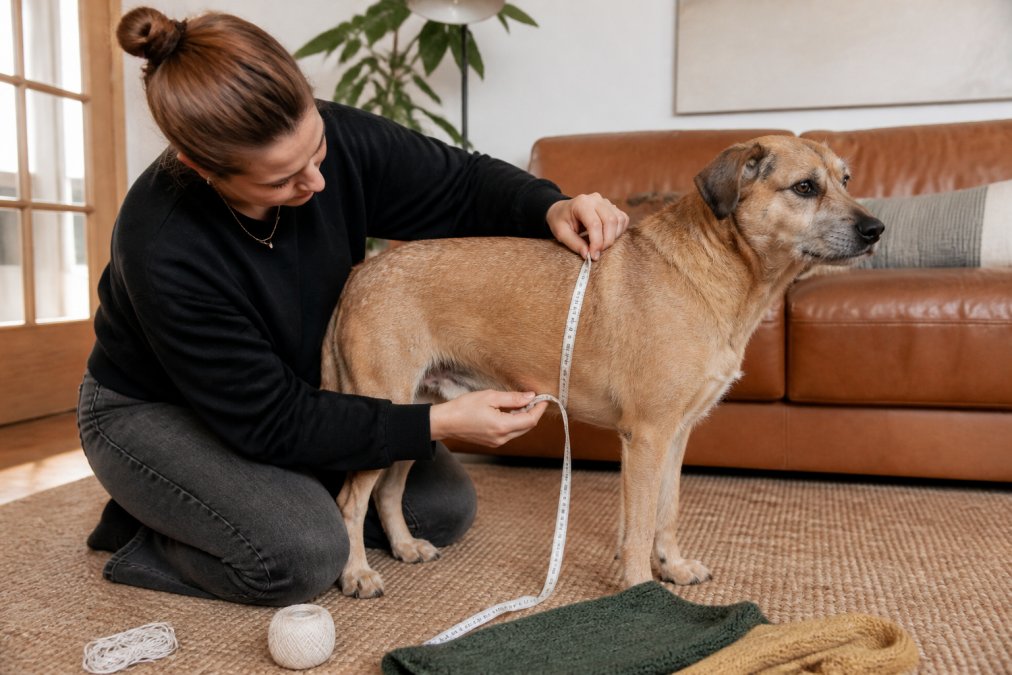
Step 1: Get Your Dog Standing Square
Before the tape comes out, get your dog standing on all four legs with their weight evenly distributed. When a dog sits, the spine curves and the back length shortens; when a dog lies down, the chest girth can read a full size smaller. Either position sends you to the wrong row of the size chart.
Measure right after a walk or a meal, when most dogs are content to stand still. Hold a treat at nose level, not above the head, a dog looking up will arch their back and throw off the length reading.
Step 2: Measure Back Length from Neck to Tail
Back length is the distance from the base of the neck to the base of the tail, measured along the spine while your dog stands. Run the tape from where the neck meets the shoulders, follow the natural line of the back, and stop where the tail begins, keeping it flat against the body.
For long-haired breeds, press down gently to the skin rather than measuring over the coat. Measuring over a thick double coat can add an inch or more, enough to push you into a size that drags at the rear (akc.org).
Step 3: Measure Neck Circumference at the Collar Line
Neck circumference is the distance around the neck at the collar line. Wrap the tape around the base of the neck, just below the jaw and above the shoulder blades, and keep it level, a tape that rides up at the back will read short.
A sweater that fits the chest but is tight at the collar will rub, chafe, and get yanked off within minutes. You should be able to slide two fingers flat under the tape at the collar line; if you cannot, the neck opening is too small.
Step 4: Measure Chest Girth at the Widest Point
Chest girth decides whether the sweater closes comfortably, and it is the one most owners get wrong. Find the widest part of the rib cage, typically just behind the front legs and elbows, and wrap the tape level around the body.
Slide one finger under the tape. If it will not fit, you are pulling too tight. Write the number down immediately, do not try to hold three measurements in your head while your dog is still standing still.
How to Measure Dog Chest for Clothes (The Most Important Number)
Chest girth is the single most important measurement when you measure dog for sweater sizing, because it decides whether the garment closes comfortably around the rib cage. If you only take one measurement, take this one.
Here's how to get it right:
- Find the widest part of the rib cage, typically just behind the front legs and elbows.
- Wrap the soft measuring tape level around the body at that point.
- Slide one finger under the tape. If it won't fit, you're pulling too tight.
- Write the number down immediately.
Chest girth governs the fit of every sweater. A garment that's snug around the chest restricts the front legs; one that's too loose slides sideways and bunches under the armpits. The goal is a snug fit that still lets you slip two fingers under the fabric at the deepest point of the chest.
Reading a Dog Sweater Size Chart Without Guessing
A dog sweater size chart maps your three measurements to a garment size, and chest girth almost always carries the most weight. Back length narrows the choice; chest girth makes the final call.
Measurement |
Where to Measure |
What It Decides |
If It's Off |
|---|---|---|---|
Back length |
Base of neck to base of tail |
Overall garment length |
Sweater rides up or drags |
Neck circumference |
Around the collar line |
Chafing or slipping off |
|
Chest girth |
Widest point of rib cage |
Whether it closes and moves |
Restricted motion or bunching |
Read the chart from the chest column first. Find your dog's chest girth, then check whether the back length for that size matches your second number. When the two disagree, trust the chest and adjust with the sweater's stretch or an adjustable closure.
Why Weight Is the Wrong Shortcut
Most size charts list a weight range, and most owners reach for it first, the single most common reason sweaters get returned. Weight tells you how heavy a dog is, not how that weight is distributed. A lean Whippet and a stocky French Bulldog can weigh the same 25 pounds and need completely different sweater sizes (avma.org).
A dog whose weight puts them in a medium may have a chest girth that puts them in a large. Trust the tape, not the scale. Weight is a starting hint at best; the three measurements are the actual answer.
What to Do When Your Dog Is Between Sizes
Between sizes is the norm, especially for long-backed breeds like Dachshunds and Corgis whose back length and chest girth rarely land in the same row. When stuck between two sizes, the material decides:
- Stretchy knits: Size down if the chest is the only measurement that is close. A knit with give will accommodate a snug chest without restricting the front legs.
- Woven or felted fabrics: Size up. These materials have almost no stretch, and a chest that is even slightly tight will bind across the shoulders.
- Adjustable closures: If the sweater has a hook-and-loop or button closure at the chest, you have room to split the difference. Choose the size that matches your back length and let the closure handle the chest.
The Two-Finger Fit Check
Once the sweater arrives, run this check before cutting any tags:
- Slip two fingers flat under the fabric at the deepest part of the chest. They should fit without straining the seams.
- Slide two fingers under the collar line. If they fit easily, the neck is comfortable; if the collar digs in, the size is wrong.
- Watch your dog walk a few steps. The sweater should stay centered, not slide toward one shoulder.
- Lift one front leg gently. The fabric should move with the leg, not restrict it.
- Look for bunching under the armpits, a sign the chest is too loose.
Dog Sweater Fit Tips for Hard-to-Measure Dogs
Dog sweater fit tips matter most for dogs who won't hold still, and the fix is timing and posture rather than technique. Measure when your dog is calm, ideally after a walk or a meal, and reward every few seconds with a treat.
For dogs who refuse to stand, try these approaches:
- The wall method: Position your dog facing a wall or corner so they can't walk forward, then measure the back quickly.
- The two-person method: One person holds a treat at nose level while the other runs the tape.
- The table method: For small breeds, place them on a nonslip surface at waist height so you're not crouching.
- The repeat method: Take each measurement three times and average them. Consistency beats a single perfect reading.
A moving dog produces a moving target: if your dog shifts, the tape shifts with them, and you end up with a number that fits no sweater on the chart.
Breed Nuances and Material Differences That Change the Fit
Breed-specific measurement nuances and sweater material both change how a given set of numbers translates into a real garment, and most size charts don't account for either.
Breed nuances to watch for:
- Deep-chested breeds like Greyhounds and Dobermans carry their chest girth far forward. A sweater sized for their back length will be too tight across the rib cage.
- Barrel-chested breeds like Bulldogs and Boxers need extra room at the chest and a shorter back length than their girth suggests.
- Long-backed breeds like Dachshunds and Corgis need a longer back measurement relative to their chest, so their sweaters often fall between standard sizes.
- Thick-coated breeds like Huskies and Samoyeds need the tape pressed to the skin, not floated over the fur.
How material changes the fit:
A knit wool sweater stretches with movement, so it can run slightly snug and still wear comfortably. A woven or felted fabric has almost no give and needs a looser chest measurement for a full range of motion. Fleece-lined sweaters add bulk without stretch, so chest girth matters even more. When you measure dog for sweater sizing in a stiff material, add breathing room at the chest; in a stretchy knit, trust the chart more closely.
Common Measuring Mistakes and a 30-Second Fit Check
Most sizing errors trace back to a handful of repeatable mistakes, and a quick fit check after the sweater arrives catches the rest.
Common measuring mistakes:
- Measuring over a thick coat instead of down to the skin
- Pulling the tape tight enough to compress the fur and skin
- Taking the chest reading at the shoulders instead of the widest part of the rib cage
- Measuring a sitting, lying, or squirming dog
- Using a rigid ruler that can't follow the body's curves
The 30-second fit check:
- Slip two fingers under the fabric at the deepest part of the chest. They should fit without straining the seams.
- Watch your dog walk a few steps. The sweater should stay centered, not slide toward one shoulder.
- Check the collar line. It should sit flat with no gap and no digging.
- Lift one front leg gently. The fabric should move with the leg, not restrict it.
- Look for bunching under the armpits, a sign the chest is too loose.
A well-fitted sweater moves with your dog, not against them. If any step fails, exchange the size rather than live with a garment that rubs.
Conclusion
Getting the numbers right takes three minutes, but it saves you a sweater that rubs, slips, or restricts your dog's stride. Measure the back length, the neck at the collar line, and the chest girth at its widest point, then let the chest number lead your size choice.
Every sweater is handmade with an adjustable fit and a smooth, chafe-free finish, so the size you order is the size your dog actually wears comfortably. Our rustic, sophisticated pieces are built to hold up through hikes, park visits, and every chic outing in between.
Shop all items at Finnegans Standard Goods and find a sweater your dog will wear as well as they wear their own coat.
Frequently Asked Questions
What are the three most important measurements for dog clothing?
Chest girth, back length, and neck circumference. Chest girth decides whether the sweater can close comfortably around the rib cage, back length sets where the hem lands, and neck circumference controls the collar line. Measure all three with a soft measuring tape while your dog stands. If a size chart lists only one number, chest girth is the one to trust most because it affects range of motion and comfort level more than the other two.
Does a dog's weight determine sweater size?
No. Weight alone cannot tell you how a sweater will fit because two dogs at the same weight can carry it very differently. A 40 lb dog might be tall and lean or short and broad, and those body shapes need different apparel dimensions. Use weight only as a starting point, then confirm with chest girth and back length on the dog sweater size chart before ordering. When weight and measurements disagree, trust the measurements.
How much extra room should a dog sweater have?
You want a snug fit that still lets you slide two fingers under the fabric at the chest and neck. That gap allows range of motion without letting the sweater twist or ride up during walks. A tapered fit through the chest and a slightly looser hem works well for most dogs. If the fabric bunches at the armpits or the collar line digs in, the sweater is too tight, not too small.
What should I do if my dog is between sizes?
Size up when your dog's chest girth falls between two sizes, then check the return policy before ordering. A sweater that is slightly loose can be layered over a thin shirt, but one that is too tight restricts the shoulder blades and rubs the armpits. If the larger size is too long in the back, look for a brand with a tapered fit or adjustable hem. Measuring twice and comparing both numbers to the fit guide prevents most exchanges.
